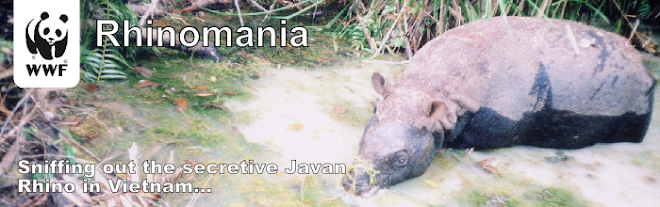
During the survey, as time went on, we became increasingly aware of the fragile existence of this rhino population. At times we would feel it was truly remarkable that any rhinos still remain here. With an ever-expanding human population around the park, signs of people in the forest were usually more frequent than signs of rhino and other wildlife.
The remaining Javan Rhinos in Vietnam


The amount of habitat which the rhinos can use is still getting smaller. Unprotected forest adjacent to the national park is being cleared every day, primarily for cashew plantations.


Within the area of forest which remains, the rhino is being increasingly restricted to the area which it can use. In the past, the rhinos used to go to the main river in the dry season. However, dams are being built on the river close to the national park, and noisy dredgers line the river – providing the necessary sand for the worrying development projects.


Low lying wet areas are likely to be important to the rhinos, but most of them have now been converted to rice paddies. One valley, important for rhinos and Gaur, has been fenced off to try to prevent domestic cattle using it and spreading disease, but they can still get through the fence.

Even within the national park, the rhino population doesn’t get a lot of peace. Rhinos like to spend the hot days wallowing in mud, or perhaps using streams and rivers. However, particularly in the dry season, hunters set up camp close to wallows, because animals are concentrated there. In the last three months we found and destroyed a new hunting camp each time we visited one particular wallow which the rhinos had been regularly using before the hunters moved in.


Evidence of people camping at wallows and making fires there is easy to find. Hunting dogs are also used quite frequently, to chase and capture whatever animal they find. We would always know when dogs had been in an area recently as our dung dogs would go crazy peeing on every nearby tree!

People also catch fish along rivers, or set traps such as this one in the photo below to catch fish, amphibians and reptiles such as this Banded Krait. This causes more disturbance in important rhino areas. Along some rivers we found a hunting and fishing camp every 500 meters, this one was still smoking.


Hunters set snares to catch animals. These snares were removed on one days survey in November. Even if not intended for the rhinos, these snares could mortally wound one. On our last visit to the forest we found a large cable snare, like the one in the center of this photo, positioned over a trail close to a popular rhino wallow.


People visit the forest for many reasons, not just to hunt animals. Although activities such as honey collecting is not a direct threat to the rhinos, the presence of people cutting and burning trees, often close to wallows to remove honey causes additional disturbance. Here, Mr. Nga (one of our local guides) examines a tree which had been felled to collect honey, and Mr. Ngoc reprimands some people caught in the act.


People chop down trees in the national park for a number of reasons, both for timber, and to obtain fruit. These trees were felled so that fruit could be collected from them, whilst the palms, which grow in swamps regularly used by the rhinos, are felled for their fronds.


With a decreasing area of suitable habitat and ongoing disturbance, the remaining Vietnamese rhinos do not get a lot of peace. The results of the survey will be so important for determining how to truly conserve this unique animal, if indeed it is not already too late…
Watch this space for news of the number of Vietnamese rhinos, when we get the DNA results!



 Posts
Posts


It has been very interesting reading this blog and it will be even more interesting to find out what the structure of the rhino population is from the DNA of the dung samples collected.
ReplyDeleteI know however that some doubt has been expressed as to whether any male rhinos survive here.
Help is on the way, I hope. We are committed here at the Cincinnati Zoo. I am a friend of Steve Chapman and gold member of the Cincinnati Zoo. As an ex peace corps volunteer and with contacts who served in Vietnam (Duncan and Robin) hopefully we can make something happen before it is too late. Let's make some noise for the Rhino's this year.
Delete