On 29th April a carcass of a Javan Rhino was found in the area where we had been doing our survey.
Read more about it here and with additional information also here
Samples are being sent for DNA analysis so that we can determine if this was one of the rhinos whose dung we collected, and therefore how many living rhinos this leaves us with.
Showing posts with label Javan Rhino. Show all posts
Showing posts with label Javan Rhino. Show all posts
Tuesday, June 1, 2010


Wednesday, December 2, 2009
Who lives in a house like this?
Those idle enough to be at home during the day-time in the UK
So join us as we go through the keyhole (put the emphasis on “through” and “keyhole” for the full effect).


There is what looks like dung in the oven (and a trapped man holding a camera)!


Consider the clues carefully - who lives in a house like this? Please remember, in rural Vietnam
Thursday, November 19, 2009
Leeches Vol.2

Monday, November 16, 2009
First trip
As our Twitter followers will know, we have returned from our first five day trip to the forest. In five days of searching we found two dung piles, both rather old. Sarah’s team found both of them.
Our team of two national park technical staff (Mr Hai and Mr Long), two rangers (Mr Thai and Mr Huong), two local guides (Mr Nga and Mr Banh) and us and the dogs camped by a beautiful forest stream for four nights. One night we heard some Guar crashing through the bamboo towards our camp, until they heard us and bid a hasty retreat!


Each day we went out with the dogs to search for rhino dung. Most days our searches led us to wallows, in this photo you can see that by rolling around in the wallow (wallowing of course) the rhino has rubbed mud onto some over-hanging leaves.

At the wallows, rhino footprints were often clearly visible. Ageing the footprints is fraught with difficulty, but the lack of fallen leaves in these prints indicate that they were made very recently.

Those footprints led out of a wallow where a rhino had been moving around. The mud was deep, you can see where the rhino’s belly has flattened the mud in between the footprints here. Again, there is no debris in the areas flattened by the rhino, this and the cloudiness of the water where the rhino has been moving around indicated to us that the rhino had been here recently, perhaps as recently as the night before.

The same rhino then moved up into the forest, brushing against leaves as it went. Here is some mud from its side stuck to a palm frond. Although it is not really visible here, where the mud on the palm was thicker, it was still damp: we must have missed the rhino by only a few hours!


And here it has just crashed right through (the bamboo stems are about the width of a big human man’s arm):

Often, trails made by the rhino are not easy to follow – try crawling through this! And all to find a pile of poop…we're back out there tomorrow for another week.

Wednesday, November 11, 2009
Monitor Lizard confiscation

While staying at park HQ, the park received a confiscation of about 260 water monitors. These large lizards are popular restaurant food in towns, and are put in large jars of rice wine for drinking on special occasions. At least 220 of the lizards were still alive so the park decided to release them. Here are a few pictures of them in the sacks they arrived in, just prior to release.

It's great that the Forest Protection Department seized these lizards, and that there is a large area of well protected habitat in the park in which to release them. However, it’s hard to know what is the ideal thing to do with such a large number of large lizards. There is always the risk of transmitting disease, but a lengthy quarantine is not really an option with so many animals. It’s not possible to put them all back where they came from, since they will have been collected over a large area and then delivered to the trader from whom the seizure was made. However, releasing them all in one place to an area where the current population and carrying capacity are unknown is also risky. Sometimes there are no easy answers, but the national park just have to do the best thing that they can do.
Monday, November 9, 2009
The beginning
Tomorrow is the beginning: the first proper day of the survey. The training is over and now will will take the dogs into the forest for five days to search for the elusive rhino dung. We'll let you know how we get on when we get back.


Sunday, November 1, 2009
Leeches vol. 1
Vietnam's forests are full of leeches. They manage to creep inside clothing that is tucked into clothing sprayed with insect repellant as easily as escapologists escape from locked boxes, only the principle is reversed. The dogs suffer as much as we do and we have to stop and remove leeches from them regularly.
Over the next six months we’ll be posting a number of posts of leeches doing what they do best. I found this leech after lunch, and after I had had a shower (I don’t know what this says for my personal hygiene standards). That’s proper persistence from the leech – he deserves a blog post!

Over the next six months we’ll be posting a number of posts of leeches doing what they do best. I found this leech after lunch, and after I had had a shower (I don’t know what this says for my personal hygiene standards). That’s proper persistence from the leech – he deserves a blog post!
Tuesday, October 27, 2009
DUNG!!!
Another training day and only our second visit to forest where the rhinos are found, this time we went one better than footprints: dung!!! We split into our two teams and met up at lunchtime at a beautiful wallow on a ridge (don’t worry, I haven’t gone rhino crazy, the wallow really was beautiful!).

See, it is beautiful
My team went up a stream, which Chevy loved, and then climbed up to a ridge and headed south to the wallow. Chevy ran up and down the stream and threw himself into all the fastest flowing bits of water. We found some three week old dung just down hill from the ridge when we had spread out to re-find the trail which we had temporarily mislaid.

Chevy and the stream which excited him so much

Sarah and her team started by going straight up a steep slope and then followed a different ridge to get to the wallow. The trail passed through dense bamboo and rattan thickets. Mr Hai, the vice-head of the technical department at the park, who accompanied my team, said that rattan was often eaten by the rhinos. On the way back we found another four dung piles, each two or three weeks old. Hai also showed us a place where a rhino had recently slept: very cool!

A rhino sleeping place
It’s really exciting to be finding so many rhino signs already, but how many rhinos are involved? It’s hard to imagine that the dung we found today was from more than two rhinos, and it’s quite possible that only one was involved in all the signs we’ve found so far in the small area that we have searched, only time and DNA analysis will tell…
Sunday, October 25, 2009
Rhino footprints!
We found our first rhino footprints today! We are still in the training phase, so for our first day in the forest where the rhinos live we took the dogs on a short walk with rangers Huong and Hong to a wallow close to our village. The wallow is located at the head of a small stream which flows into rice paddies a couple of a kilometers from the house where we are staying.

A few years ago the paddies surrounding the wallow were fenced off and allowed to revert back to natural vegetation, to reduce disturbance to the wallow which is used by both Gaur (a species of wild cattle) and the rhino. Now the fields support a mixture of grasses and sedges growing in the swampy ground. We didn’t actually manage to get to the wallow because the mud was too deep, but there were many footprints and rhino paths through the grassland close to it. The rangers thought that the prints were about a week old.

No dung yet but a very exciting start for our first trip into the field!

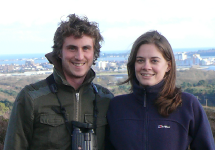
Sarah and Steve in the field
A few years ago the paddies surrounding the wallow were fenced off and allowed to revert back to natural vegetation, to reduce disturbance to the wallow which is used by both Gaur (a species of wild cattle) and the rhino. Now the fields support a mixture of grasses and sedges growing in the swampy ground. We didn’t actually manage to get to the wallow because the mud was too deep, but there were many footprints and rhino paths through the grassland close to it. The rangers thought that the prints were about a week old.

Rhino footprint, honest
No dung yet but a very exciting start for our first trip into the field!
Saturday, October 17, 2009
The art of poo detection
.JPG)
 After one week of intensive but enjoyable and enlightening training (I feel like my relationship with dogs has been simply but miraculously transformed for the better!), the dog and human teams have been decided. So who is with who? Well perhaps anyone could have guessed that the female would work better with the sensitive, highly strung (but intelligent!) border collie and the male with the dozy, amenable, beefcake labrador! So it’s Simon and Chevy versus me and Pepper, the race will soon be on to see which team will top the dungometer!
 But for now the training continues. The dedication and obsession of these dogs is really quite amazing! A few minutes of play with a ball and some well deserved praise is ample reward for the dogs to search the hot humid rainforest for hours a day for traces of rhino poo and they will not rest until they have found it! Hook them up to their orange harnesses with jingling bells to warn any impending animals of our approach and the dogs are raring to go!
Chevy and Pepper were trained by Packleader back in the states on general rhinos using poo from captive Indian, Black, White and Sumatran Rhino from White Oak Conservation Centre, as there are no Javan rhinos in captivity anywhere in the world. The technical staff at the park provided us with 3 frozen Javan rhino poos when we arrived, which we broke up, placed into small bags and have been putting into the forest on and off trails at varying distances, to train Simon and I in the art of detector dog work. Both dogs got the Javan Rhino poo straight away, so no worries there! As long as the rhinos poop in the park and we work with the dogs effectively, we should find enough of it!
 Steve has been leaving early morning to plant the poo in the forest on different trails each day and Simon and I take it in turns to work one dog through, watching each other and learning from practice and from Steve’s extensive experience as we go! I have to admit it is not as easy as I had thought it would be! We have to have 100% concentration on the dogs, guiding them to search on both sides of us, making sure they aren’t working too fast, watching for any dangers (snakes or spiny plants), paying close attention to recognise when the dogs are on the scent of rhino poo. So much so that we will need someone to navigate for us in the field to ensure we do not wander off into the forest never to be seen again! The dogs’ behaviour changes when they are on the trail of a poo, working methodically to find the source, Pepper typically stops and freezes in crouching position staring at the sample, waiting for me to verify that it belongs to rhino and then throw the ball his way in reward. After a few minutes play, a check for leeches (there are thousands of the sneaky bloodsuckers here, usually attracted to Simon who smells a little more through changing clothes a little less than is perhaps polite for fellow fieldworkers!) and some coaxing of the dog to stop thinking of the ball and take a minute for a drink, we ‘get back to work’ to find the next poo sample! We have learned that timing and tone is absolutely key with these dogs, too soft and the dogs are too excited to listen to you calling them back, too slow and they get impatient and move away from the sample towards you to see what is taking you so long with their reward! So although we have the gist of it for now, we need to refine our skills and our relationships with the dogs in the next week or so, before we make the move to the target area.
Wednesday, October 14, 2009
No birding!!!! AAAAARRRRGH!!!!!
I’m rapidly learning a thing or two about finding poo with dogs, and one thing I’ve learnt in the last couple of days is that working with dogs and looking for birds are incompatible activities!!! Aaaarrrgh!!! The first thing I think of when I see a piece of forest is what birds are in there? How can I get in? I want to see the birds, no, I need to see the birds! But when working with the dog, I can’t. I have to concentrate on the dog and what it’s doing 100% of the time. There’s no time to raise the binoculars and take a look at something flitting around in the branches that’s caught my eye, or to stop and tape in something that sounds interesting. It’s just work, work, work. Stare at that dog as he searches for poo. Read his body movement so that you can see when he zeros in on the smell of the poo above the general sniffing of forest odors. Watch him intently in case he catches the scent of something to chase, call him back firmly, praise his return and resume the search. No time for birding. Help!!!!
But, I’m here in the national park all day every day, one of the best bits of forest in Vietnam. I’m not in the office in Hanoi anymore with the Tree Sparrows, Japanese White-eyes, Red-whiskered Bulbul and White-throated Fantail my only avian companions. Here when I work I can look at no birds, but while the dogs rest, I can play. A short recce of a trail for dog training yesterday afternoon produced a pair of Germain’s Peacock-pheasants, and in the morning while leaving the cabin a Woolly-necked Stork flew overhead. There may be no birding during work time, but there wasn’t in Hanoi either, and it’s just great to be living in the forest and able to see birds at other times. As long as I keep getting my fix, I won’t become a gibbering wreck …
Sarah on the other hand, does not have the obsessive compulsive disorder of birding and is just very happy to be in the forest, surrounded by nature and in the company of two lovely dogs again (and me of course)!. What a well balanced individual!.
But, I’m here in the national park all day every day, one of the best bits of forest in Vietnam. I’m not in the office in Hanoi anymore with the Tree Sparrows, Japanese White-eyes, Red-whiskered Bulbul and White-throated Fantail my only avian companions. Here when I work I can look at no birds, but while the dogs rest, I can play. A short recce of a trail for dog training yesterday afternoon produced a pair of Germain’s Peacock-pheasants, and in the morning while leaving the cabin a Woolly-necked Stork flew overhead. There may be no birding during work time, but there wasn’t in Hanoi either, and it’s just great to be living in the forest and able to see birds at other times. As long as I keep getting my fix, I won’t become a gibbering wreck …
Sarah on the other hand, does not have the obsessive compulsive disorder of birding and is just very happy to be in the forest, surrounded by nature and in the company of two lovely dogs again (and me of course)!. What a well balanced individual!.
Tuesday, October 13, 2009
The Dung-Sniffing Dogs
 It’s been a busy few days and so I’ve got a bit of blogging to catch up on. The day before yesterday we went to Ho Chi Minh city to meet Steven Weigley and the dogs, Chevy and Pepper from Packleader LLC, near Seattle in the USA. While waiting for Steve we saw the Thailand under 21s football team (soccer to those of you in the nations where they stole the word football and applied it to a totally different sport) arrive for a tournament. The dogs were very pleased to be in Vietnam and we got them out to stretch their legs after their 24 hour journey. Then it was a long car journey back to our headquarters, finally crossing the river into the park at dusk.
  On Friday we began our training. Steve is here for a month to train me and Sarah to use the dogs to find the rhino poo. The dogs need to get used to working with us, and to the local conditions, including the heat, humidity and all the new smells of the Vietnamese rainforest. The two dogs are totally different, in appearance and character but similar in their obsession over their ball making them great detector dogs. Both were rescued from the pound as the traits that make them good detection dogs usually don’t make good pets! Chevy is a chocolate Labrador crossed probably with a Pointer. He’s a bouncy, strong-willed dog constantly interested in whatever the environment has to offer! This means he often gets himself into trouble, proved early on in his second day here when his inquisitiveness and eagerness landed himself in a big water-filled ditch and had to be pulled out! Pepper is a slightly built Border Collie, he’s quieter than Chevy, sweet-natured and eager to please and always ready to go to work! The dogs are resting now after a hard morning of work, while we dine on egg fried rice and chicken. Soon it’ll be time get back on it.
 Thursday, October 8, 2009
Here we are!

Home Sweet Home: the grey hut behind the ranger station
It’s a wet morning at our headquarters in the national park. We are currently staying at the park head-quarters, where we have now been for a couple of days. So, what are we doing here I hear you cry. Well, as you’ve probably guessed it’s got something to do with rhinos, in Vietnam. Rhinos in Vietnam!? Yes, there’s a few, probably less than ten (although I hope there are at least a couple more) and perhaps as few as two or three. And all these rhinos are in southern Vietnam. Outside of Vietnam there is only one other population of Javan Rhinos, in Ujung Kulon National Park on Java, Indonesia, where the population is about fifty individuals.
We are down here to survey the rhinos, comprehensively. In conservation it’s a very rare occurrence to have a total population estimate, but we hope to get just that: after the survey we should know how many rhinos there are, what sex they are and (hopefully) whether or not they’re in the mood for breeding. This information will guide WWF, the Vietnamese Government and park management on what should be done next to save the Javan Rhino in Vietnam. To try and detect all the rhinos we are going to use specially trained dogs to sniff out rhino dung from which we will collect samples for DNA and hormone analysis. We will cover the whole area where the rhinos are thought to persist (4,000 hectares) and an additional 4,000 hectares of adjacent forest a number of times to try and ensure that we detect dung from all the remaining individuals. 4,000 hectares is a rather small area for a population of rhinos! Wales is the traditional unit of measurement for rainforest area in the popular press, but 4,000 hectares is significantly smaller than Wales: the rhinos are thought to be restricted to an area less than half the size of Merthyr Tydfil.
Today we have been meeting with the technical department of the national park to discuss plans for the survey. The survey won’t start until early November. Before then we have a month of training in using dogs to find rhino dung. The dogs fly into Vietnam tomorrow with Steve, the trainer, and then the training begins. Yesterday we went with Ms. Thuy and visited the project house, our new home in a village close to the forest. Since the rhinos are located a long way from the park headquarters it makes good sense to stay in a village close to the forest, but we will have to get accustomed to village life! The house is being built behind the guard station, we will probably move in next week, when it has been finished. Yesterday we met our new neighbours, the six rangers and their three dogs, I hope the 13 of us will be one big happy family!
The rain has now stopped and the birds and insects are singing again, time to get some lunch and go into the forest.
Friday, October 2, 2009
Three Days to Go...
It feels like we've been preparing for this survey for ages! But finally, after almost a year of planning and fundraising, we have booked the tickets - there's no turning back now. At 11 am on Sunday we fly from Hanoi to Ho Chi Minh City in the south of Vietnam to begin six months of field work to determine the population status of the Javan Rhino in Vietnam. We'll write more about the survey and the rhinos themselves in future posts.
Sarah has been designing this project for much of the last year, amongst other things, so she's very familiar with all the rhino stuff by now. Meanwhile, I have been working for BirdLife in Indochina, as a conservation adviser. I left my previous job only a few days ago, so this all feels very new and I'm full of enthusiasm for the project.
Today was my first day in the WWF Hanoi office. I was taught how to blog and how to tweet (is that a verb?). I’ve shunned these new technologies for as long as I possibly could, but now I will be twittering with the best of them. I went for lunch with Tran Minh Hien (Director) and Ruth Matthews (Programme Manager). They are very excited about the project, and I think that they’ll miss having Sarah around the office too. After lunch I did a bit of last minute shopping for the project and headed out with Sarah and John Pilgrim (still of BirdLife in Indochina) for a pie and a pint. There are no pies out there in Southern Vietnam's wilderness….
Subscribe to:
Posts (Atom)

 Posts
Posts


